
Ask a coding agent for a page and it comes back in Tailwind. Nobody chose that.. Tailwind became the default for generated interfaces and it is also why generated interfaces look alike.
Why do agents reach for Tailwind?
Four reasons, none of them about taste.
- The vocabulary is closed.
flex items-center gap-2is three tokens from a finite list, where a stylesheet needs a name, a selector and a file kept in agreement across every later edit. - It is where the training data is. shadcn/ui and the generators built on it (v0, Bolt, Lovable) emit Tailwind by default, and a model that has read that corpus writes that corpus.
- The style sits in the markup. One file shows the whole component, with no stylesheet to open, no cascade to reason about and no name to get wrong.
- A machine can read it. A class string is something a linter checks in one pass, and a stylesheet is not.
That last point is also the argument for design tokens, and it cuts the other way: a token that looks like a class (text-muted-foreground, border-border) is as readable to a machine as Tailwind's own utilities.
check your own project
Ask your agent for a component, then ask it for the same component with a separate stylesheet. Count the decisions it had to invent in the second version: names, selectors, files. Each one is a place the next edit can drift.
What does it do to the look of the output?
It makes correctness cheap and sameness just as cheap. The same hundred utilities carry almost every page an agent writes, and when nothing constrains the values (a palette, a type scale, a spacing ladder) the defaults win: Tailwind's greys, Tailwind's text sizes, the operating system's font, the same three-card row.
We can put numbers on the "same hundred" from our own catalog, 14 themes written by agents under one contract and one lint:
- 36,023 class occurrences, 1,155 distinct utilities
- 31 utilities carry half of all usage, 115 carry 80%, and 365 appear exactly once
- five of the nine most-used classes are token utilities defined in the theme, not in Tailwind
| Utility | Uses | Whose |
|---|---|---|
text-muted-foreground | 1,823 | token |
flex | 1,612 | Tailwind |
text-foreground | 1,228 | token |
border-border | 1,174 | token |
font-mono | 957 | Tailwind |
items-center | 933 | Tailwind |
type-caption | 746 | token |
border | 705 | Tailwind |
rounded-themed | 639 | token |
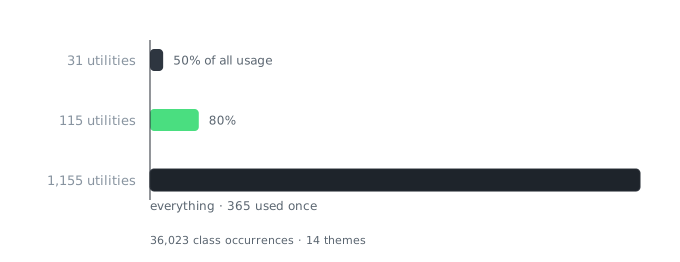
The narrow head is the agent's working vocabulary. Distinctiveness, where it exists, lives in the tokens a theme declares (49 to 109 per theme in ours) and in the rules that say what a token has to fund. Tailwind is the syntax.. it was never the design.
check your own project
List your own top 20 classes: split every className on spaces, count, sort. If none of the twenty is a utility you defined, your design system is Tailwind's defaults plus whatever the agent remembered.
Where does this break?
Tailwind makes the gate possible, not the design. Every generic tell we have measured on ourselves, an accent 5.4 degrees from its primary, a density register of 1.33 to 1, the operating system's font, happened inside Tailwind and passed a colour lint.
A lint that reads classes bans colour leaks, not layout leaks. Our catalog runs 21.9 arbitrary values per 1,000 classes. 394 of them are raw literals like grid-cols-[1fr_auto] and max-w-[62ch]; zero are colours.
The default will move. Whatever the next widely copied component library emits is what the next generation of agents writes, and the machine-readable argument applies to that too.
If you want to see a token file that make a generated theme readable by the next agent, every theme in the catalog ships both in its agent kit: how agents use the catalog.
The "why" section is reasoning about how models learn, not a measurement. The numbers are ours, from one catalog under one contract. Both are in the open to disagree with.