sent here for Switchyard
ai agent dashboard template nextjs · React and HTML source
SwitchyardAI agent dashboard template Next.js
An AI agent dashboard template for Next.js that makes multi-agent work inspectable instead of decorative.
- 79 / 79
- light / dark tokens
- 2
- modes, both designed
- 1
- DOM, rendered twice
- unlimited projects, client work included
- 12 months of updates
- 14 days, no questions
AGENTS.md and 4 skills ship in the zip, so your own agent keeps changing it after you buy.
docs: install, use, customizepages, composed from 27 sections
Every page is a real render from the publish gate, in the mode on show. Open any of them in the live preview.
- Overview/
- app-shell
- operations-overview
- workflow-stitch-preview
- safety-summary
 Workflows/workflows
- app-shell
- workflow-browser
 Workflow editor/workflow
- app-shell
- workflow-canvas
 Templates/templates
- app-shell
- template-library
 Runs/runs
- app-shell
- run-ledger
 Run detail/run
- app-shell
- execution-trace
 Approvals/approvals
- app-shell
- approval-queue
 Chat/chat
- app-shell
- chat-workspace
 Agents/agents
- app-shell
- agent-roster
 Agent configuration/agent
- app-shell
- agent-config
 Evaluations/evals
- app-shell
- eval-suite
 Evaluation detail/eval
- app-shell
- eval-header
- score-comparison
- failure-clusters
- eval-case-table
- +2
 Tools/tools
- app-shell
- tool-catalog
 Knowledge/knowledge
- app-shell
- knowledge-library
 Guardrails/guardrails
- app-shell
- guardrail-bench
 Activity/activity
- app-shell
- activity-log
 Usage/usage
- app-shell
- usage-report
 API keys/api-keys
- app-shell
- api-key-console
 Settings/settings
- app-shell
- settings-console
 Components/components
- app-shell
- operations-overview
- workflow-stitch-preview
- safety-summary
- workflow-browser
- +23
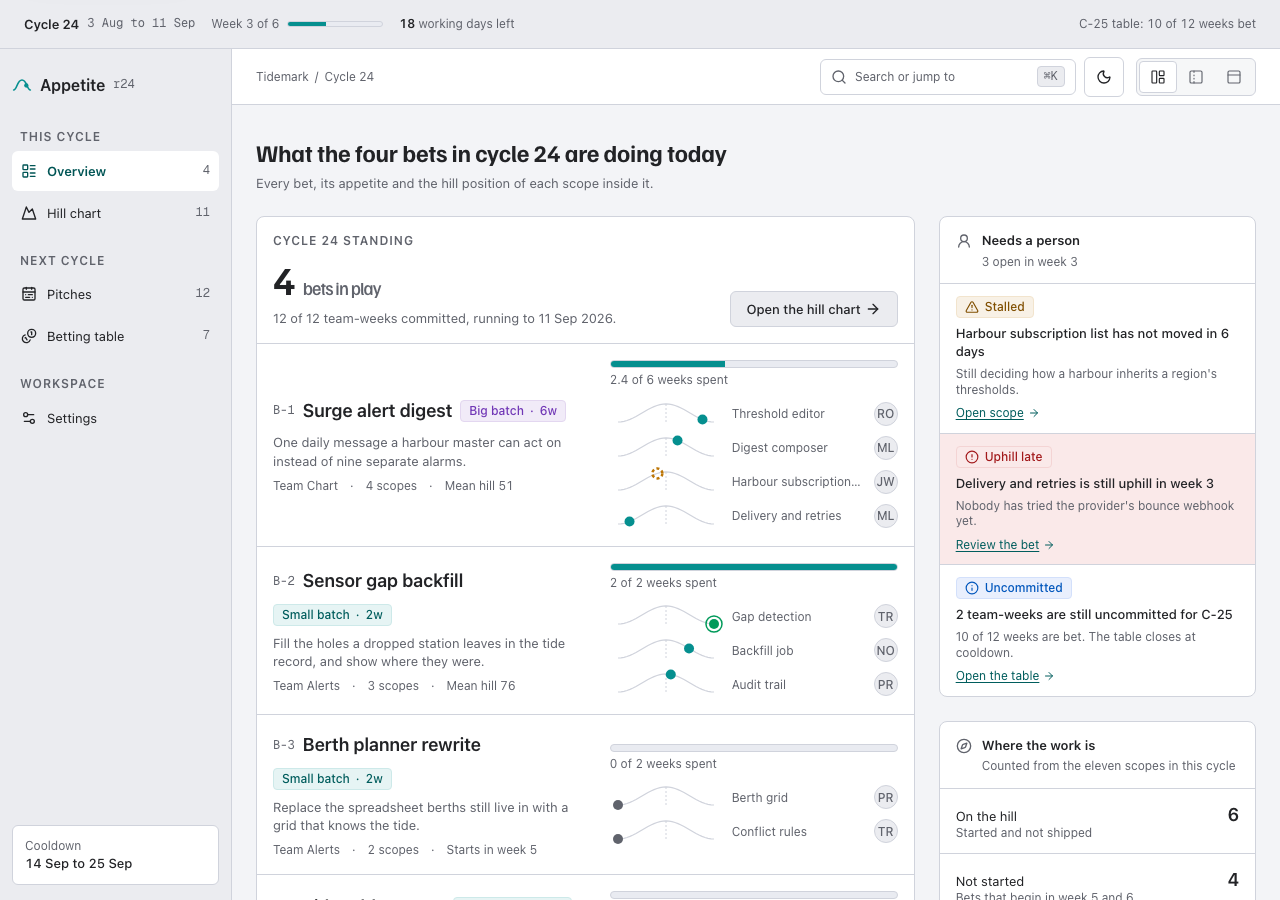
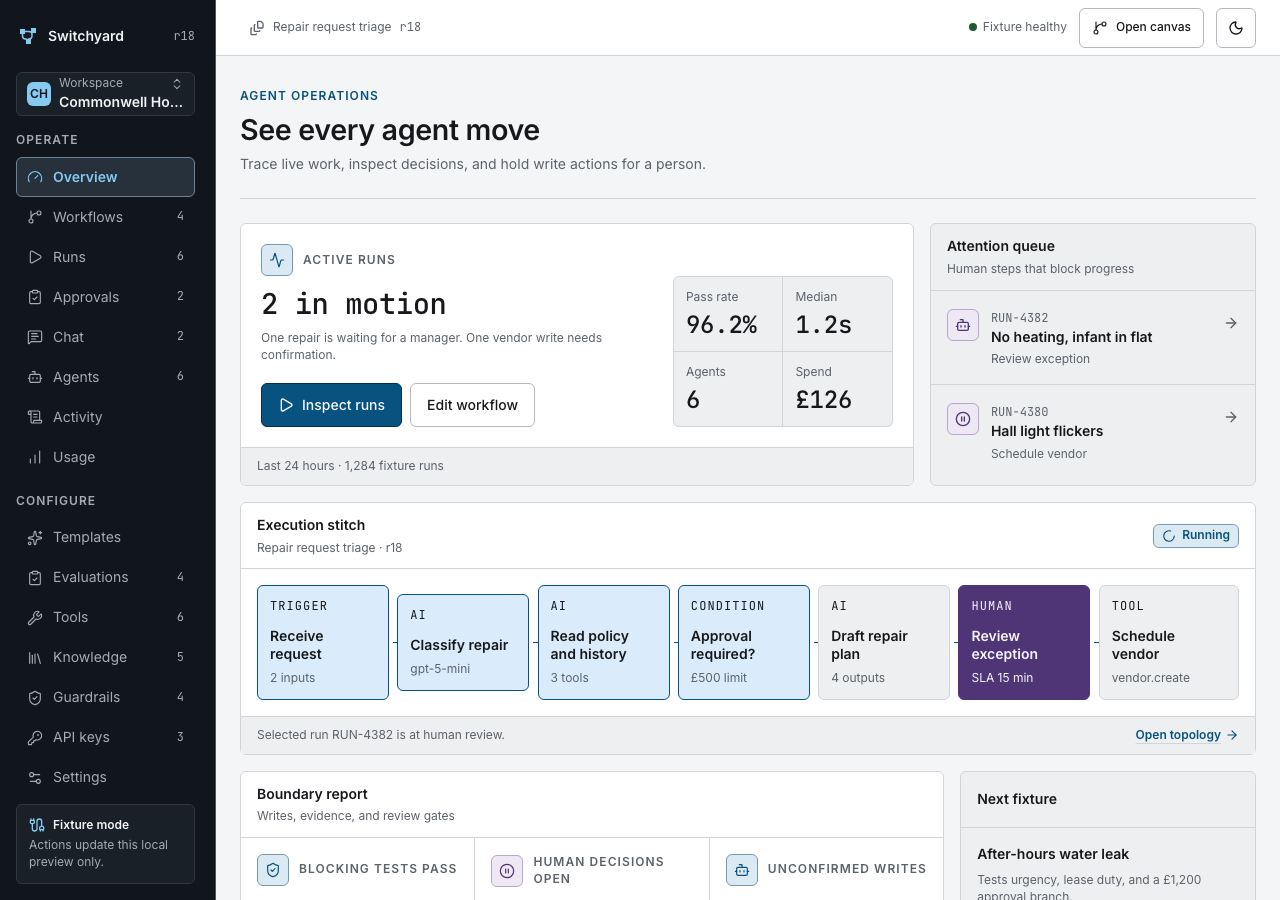
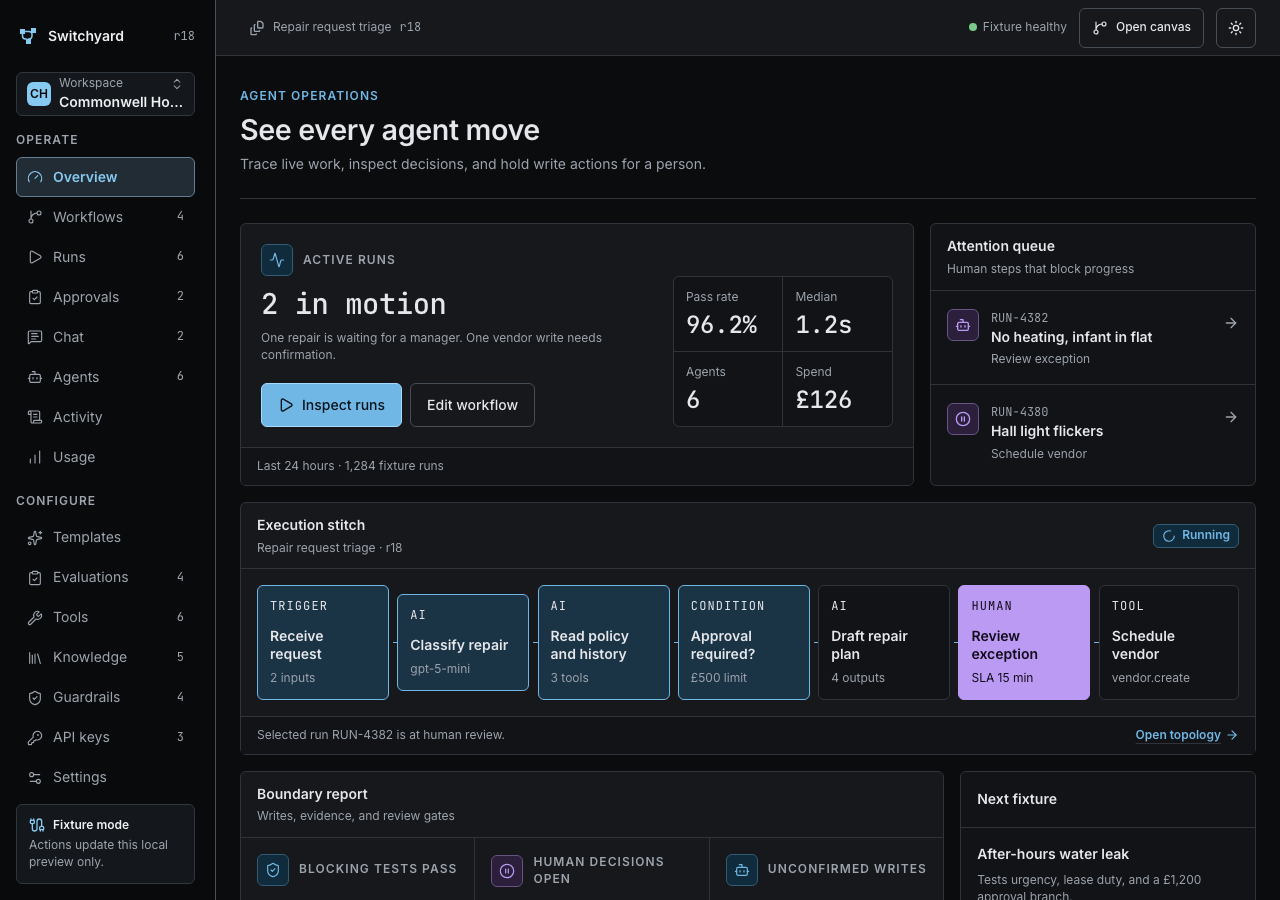
Switchyard ships twenty routes for workflow browsing and editing, canonical Wire Diagram topology, run filtering and execution traces, human approvals, an evidence-backed chat workspace, six agent profiles, joined evaluation comparisons, API keys, tool permissions, retrieval collections, guardrail fixtures, activity, usage, model routing, budgets, environments, and a living component guide. The Commonwell Housing fiction follows one repair request from resident message to classified urgency, cited policy, human spend approval, confirmed vendor write, and resident update. The execution stitch is the signature: one graph becomes the editable canvas, chronological run tape, and agent boundary ledger without duplicating node facts. Evaluation detail compares only same-case measured outcomes, keeps coverage separate, derives baseline-to-candidate clusters and unique blockers, charts exact data with a table alternative, projects restricted access safely, and records permission-aware local decisions without claiming promotion. Working local controls cover node selection, inspector tabs, run filters, expandable steps, case sorting, filtering and pagination, chat composition, fixture tests, approval previews, masked key previews, agent settings, and draft saves. Actions are honest simulations and previews; backend orchestration, secrets, auth, and persistence remain buyer integration points. Light mode uses a neutral gray canvas, white cards, subtle borders, and a custom dark rail; dark mode becomes a near-black control room. Inter and JetBrains Mono ship locally, every color routes through semantic tokens, both modes meet computed WCAG AA, and motion respects reduced-motion preferences. All twenty routes also ship as a framework-free HTML template, compiled to standalone documents with local fonts and vanilla JavaScript, and no build step between the download and a static host.
sections and primitives
You get the parts, not just the demo site. Every frame is a real capture from the theme's own styleguide page, and the source path under it is where the file lands in your project. 36 frames cover them, with 12 primitives sharing the ui/* frame.
tokens, both modes
Change one variable and every part follows. Each badge is one token split down the middle: its light value on the left, its dark value on the right, with the theme's own paired ink on both halves.
hover or tab a badge for its name and both values, enter copies
The execution stitch: one canonical Wire topology becomes an editable canvas, chronological run tape, and agent configuration boundary
every token
typefaces, self-hosted
Real woff2 files in src/fonts/, wired through next/font and licensed under OFL. Nothing is fetched from Google at build time, so the zip renders these letterforms offline. Scale ratio 1.2.
Switchyard
An AI agent dashboard template for Next.js that makes multi-agent work inspectable instead of decorative.
const { open, close } = useLedger("2026-03") // 0123456789
- display
- Inter
- text
- Inter
- mono
- JetBrains Mono
- captionAg
- smallAg
- bodyAg
- leadAg
- d1Ag
- d2Ag
- d3Ag
- d4Ag
every width is a real render from the publish gate
Four viewports, each one a render the gate produced and checked. Switch between them: the frame narrows exactly as a window does, because that is what it is.
every token and every part on one page
The styleguide route is not documentation about the theme. It is a page in the zip that renders the real components from the real tokens, so it stays true the day you change one.
files in the zip
Two independently authored editions: React for applications, plus ready HTML, CSS and vanilla JavaScript for static hosts.
- AGENTS.mdthe theme's own rules, written for an agent
- .claude/skills/4 skills, each one job
- add-page/SKILL.mdCompose a Switchyard route from existing console sections and register it without breaking the Wire, heading, navigation, or fixture contracts.
- add-section/SKILL.mdAdd a self-contained Switchyard console section with semantic tokens, fixture-backed copy, interaction states, manifest wiring, and styleguide coverage.
- check-quality/SKILL.mdVerify Switchyard's tokens, Wire boundary, content, accessibility, captures, type safety, build, and buyer package before publishing.
- rebrand/SKILL.mdRebrand Switchyard through its machine-metal tokens while preserving computed contrast, the execution stitch, and status semantics.
- src/
- theme.css79 tokens, light and dark
- fonts.tsthe faces, wired to the type tokens
- app/20 files
- components/25 files
- ui/25 files
- assets/1 file
- fonts/2 font files, 2 licenses
- app/20 routes, plus layout.tsx and globals.css
- theme.jsonthe manifest: tokens, components, pages
- html/the framework-free edition
- dist/20 compiled routes, deploy-ready — no build step
- src/the Nunjucks source the routes compile from
- scripts/build-html.ts · serve-html.ts — `bun run build:html` / `preview:html`
- README.mdquickstart
- 6 project filespackage.json · tsconfig.json · next.config.ts · postcss.config.mjs · env.d.ts · .gitignore
Your key goes in TAILTHEMES_LICENSE_KEY, and the registry entry goes in components.json. The snippet is on the docs page.
skills your agent can run
Your agent reads AGENTS.md before it edits, then runs the skill that fits the change. The skills are the theme's own, and the publish gate makes an agent complete every one of them in a scratch copy before the theme goes live.
47 components, 20 pages and 79 tokens, as a Next.js project.
AGENTS.md carries the design spec. Each skill is one job written against it.
Claude Code, Codex, or any agent that reads AGENTS.md. It runs on your machine, on your own account.
Built from the theme's own sections, on the same tokens and the same rhythm.
The source is yours to run, edit and deploy.
The spec ships inside the folder, so the page your agent adds next month is built by the same rules as the ten it came with. Nothing calls back here.
What the standard license coversWhat do I actually get?
Does it include the pages I'd otherwise have to build?
Will it work with my stack?
How long before it stops looking like a template?
Can I use it for client work?
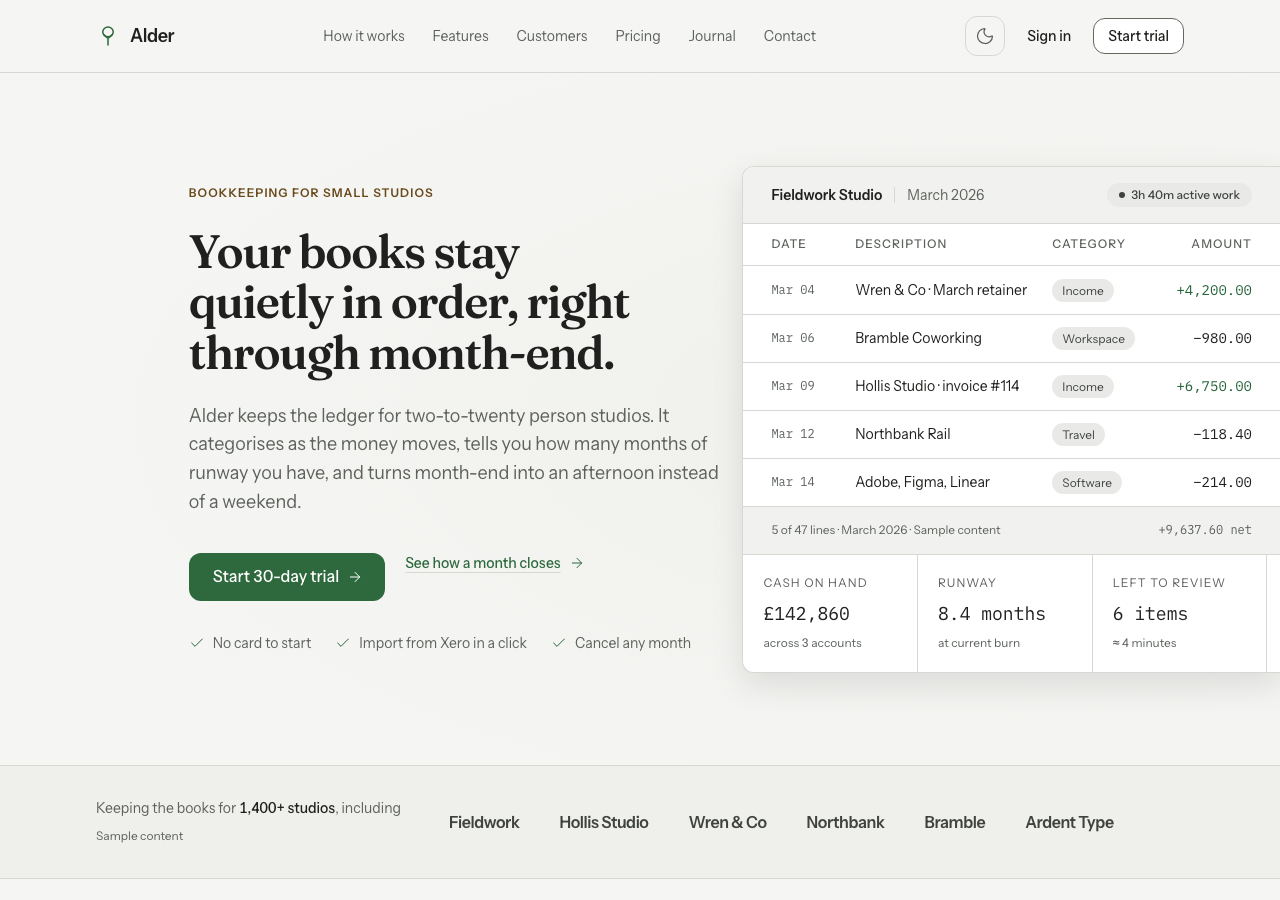
The dashboard needs a front door.
Switchyard is what your customers use. Grove is the page that gets them there — same Tailwind version, same token architecture, so the marketing site and the product do not look like two different companies.
activity
- v1.7.2: The workflow editor opens with all eight nodes in view, registers collapse to cards on phones, usage bars are flat, and case titles and delta tiles stay on one line.
- v1.7.1: The rail's Fixture mode plate sits whole above the fold, Open canvas is a quiet button, and resting statuses are neutral so Review is the colour that asks for you.
- v1.7.0: The 220-line overlay engine is deleted; eight parts vendored, 44 of 58 captures byte-identical
- v1.6.0: Every overlay now closes as deliberately as it opens
- v1.5.0: Nine primitives on one overlay hook — dialog, menu, tooltip, toast, tabs, date picker, skeleton, progress — plus a rail workspace switcher that finally does something
- v1.4.3: Docs now name the HTML scaffold for what it is and the route wiring every addition owes
- v1.4.2: The rail plate and secondary buttons stop shouting over the active item, and the execution stitch highlights on a soft brand blue instead of gray
- v1.4.1: Focus no longer stolen to the page heading on load, honest workspace plate, real key-name validation with a visible invalid state
- v1.4: Separate Nunjucks source and framework-free HTML output for all 20 routes
- v1.3: Joined evaluation detail with truthful comparison, exact cases and local promotion receipts
- v1.2: Light-blue selections and recessed form controls across the console
- v1.1 — calmer page headings and icon-anchored operating metrics
- v1.0.0 — 19-route agent operations console with canonical Wire workflows, approvals, evaluations, API keys, usage and settings
- connect fixture actions to a buyer orchestration backendplanned
- add deployment promotion once the buyer selects a runtimeplanned
for agents
This listing is also a markdown document and a JSON endpoint. The theme's own agent kit is on the kit and agents plates above.