sent here for Tare
at a glance: Tare
veterinary clinic tailwind template · React and HTML source
Tareveterinary clinic Tailwind template
Tare is a veterinary clinic tailwind template for the developer building a site for an independent small-animal practice whose clients ask what a spay costs for a 30 kg dog.

- 86 / 86
- light / dark tokens
- 2
- modes, both designed
- 1
- DOM, rendered twice
- unlimited projects, client work included
- 12 months of updates
- 14 days, no questions
AGENTS.md and 4 skills ship in the zip, so your own agent keeps changing it after you buy.
docs: install, use, customizepages, composed from 27 sections
Every page is a real render from the publish gate, in the mode on show. Open any of them in the live preview.
- site-header
- hero
- species-index
- band-sample
- tonight
- +1
- site-header
- fee-board
- flat-fees
- register-end
- site-footer
- site-header
- species-opener
- first-year
- species-care
- species-fees
- +2
- site-header
- species-opener
- first-year
- species-care
- species-fees
- +2
- site-header
- species-opener
- first-year
- species-care
- species-fees
- +2
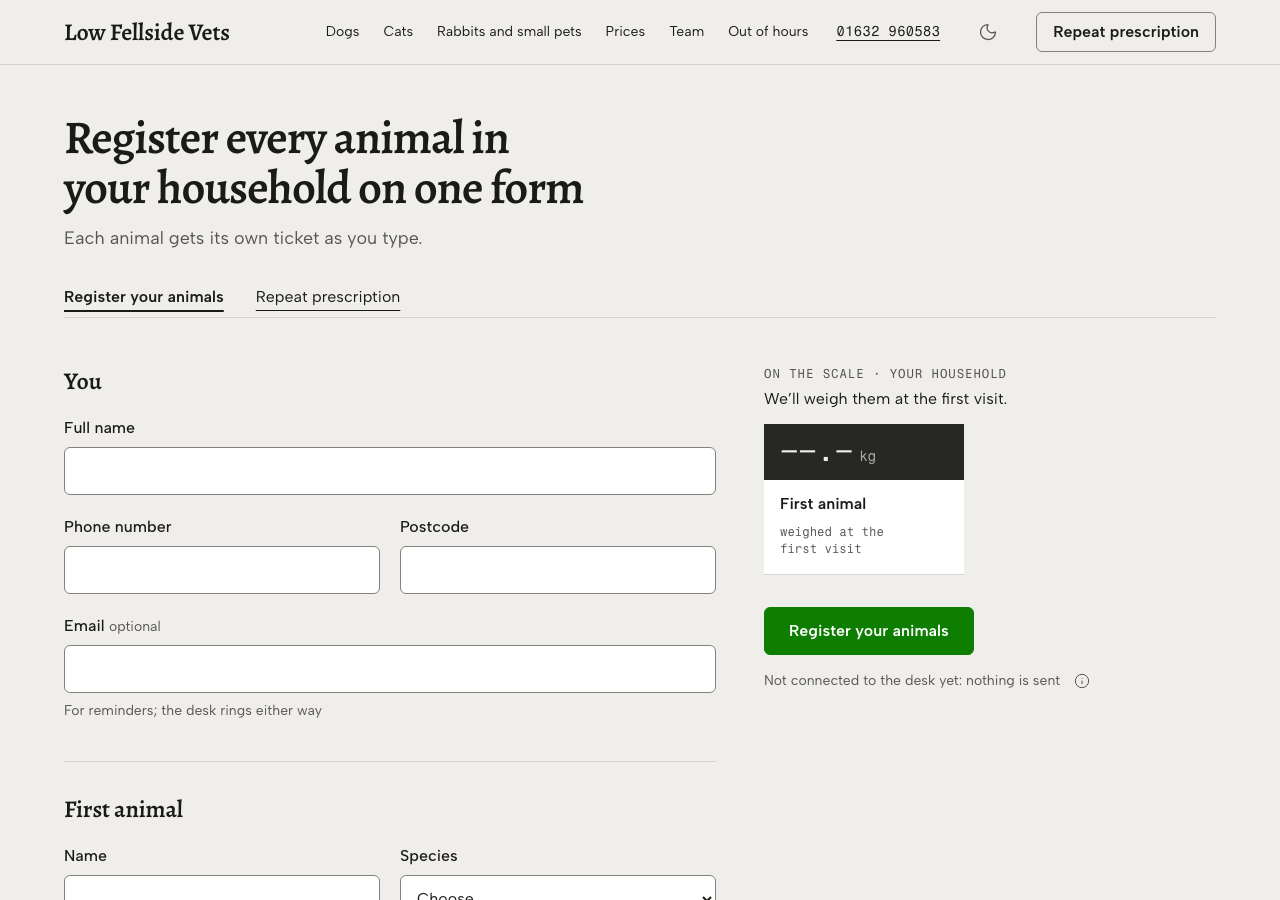
- site-header
- register-head
- register-household
- repeat-prescription
- site-footer
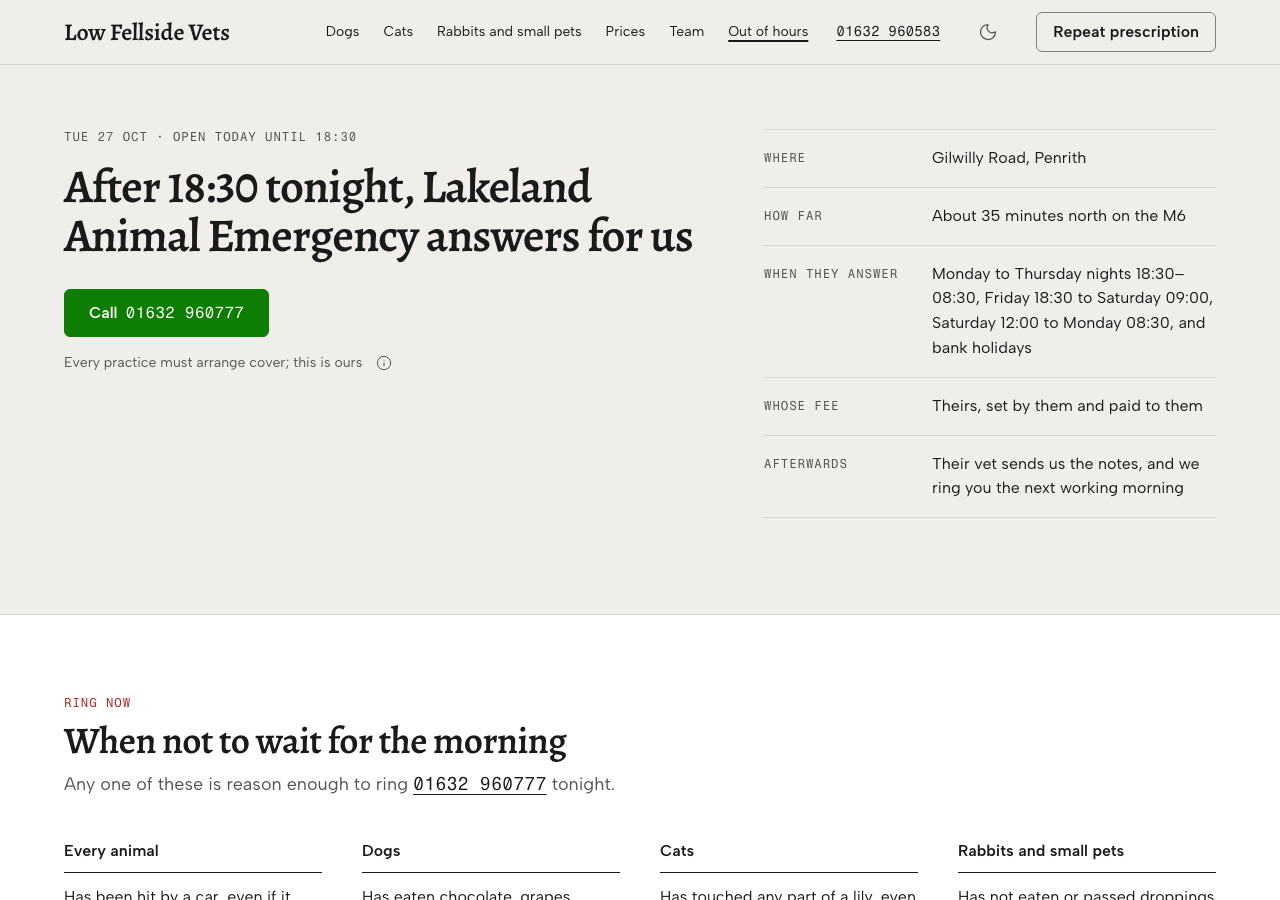
- site-header
- handover
- ring-now
- night-visit
- site-footer
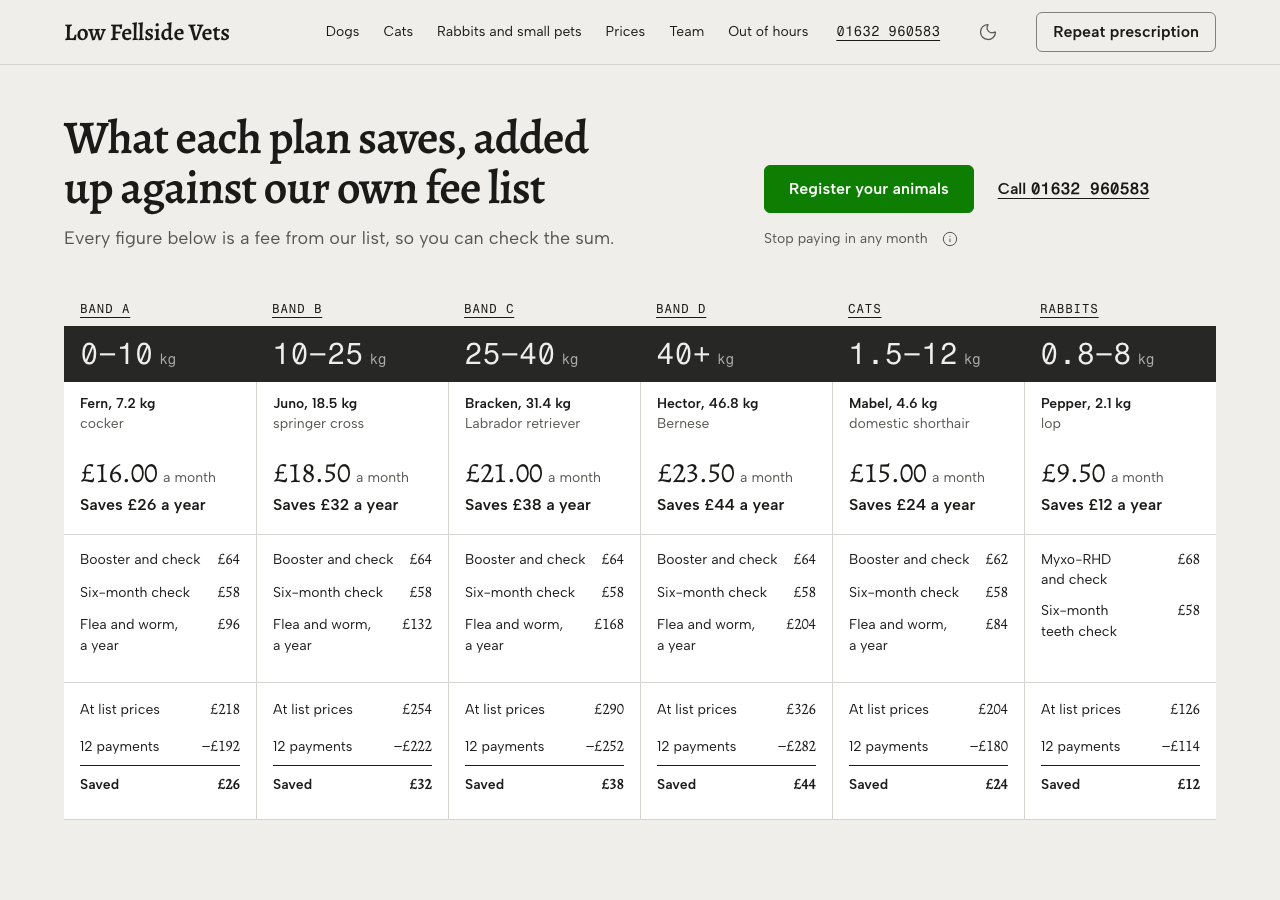
- site-header
- plan-board
- plan-terms
- register-end
- site-footer
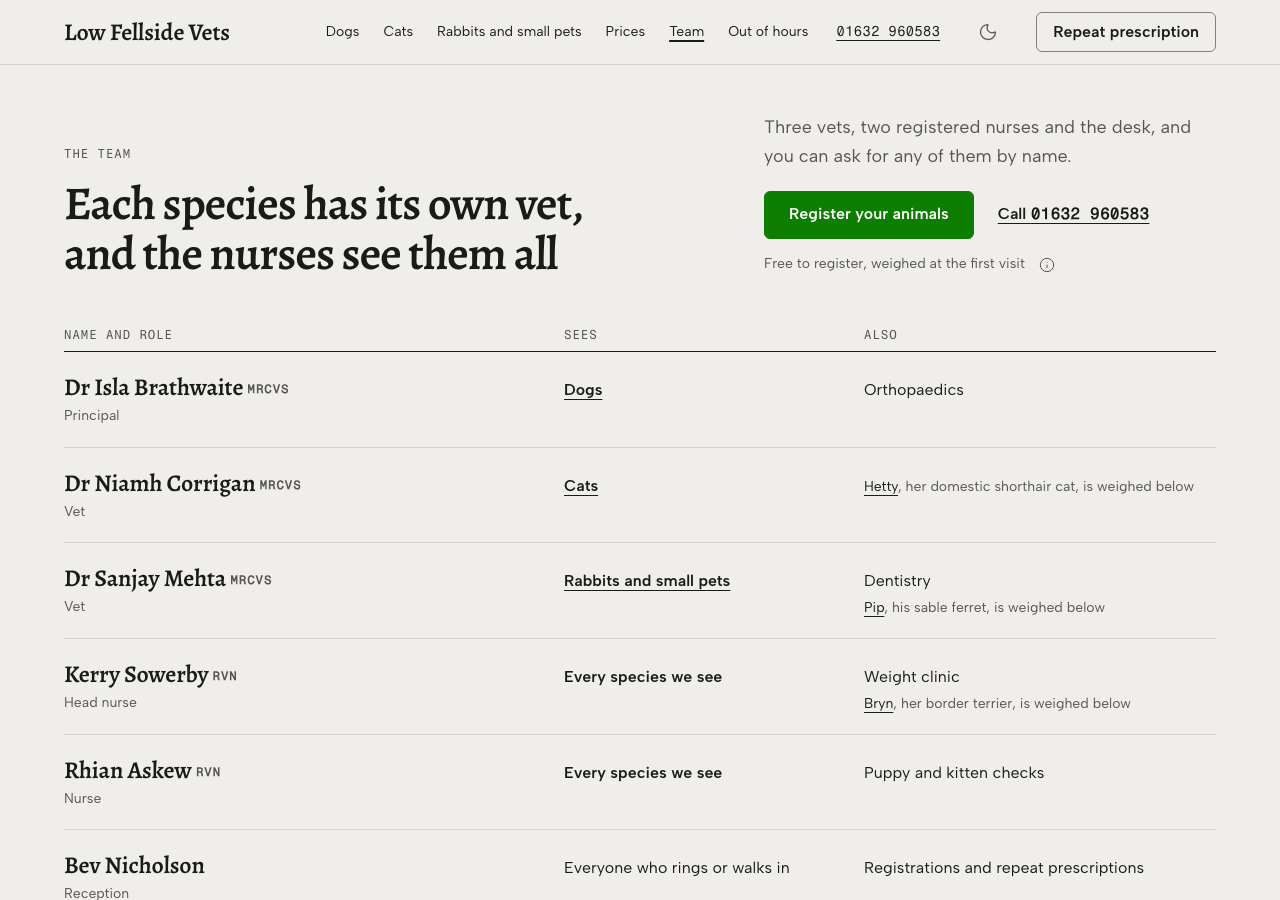
- site-header
- team-roster
- team-animals
- register-end
- site-footer
- site-header
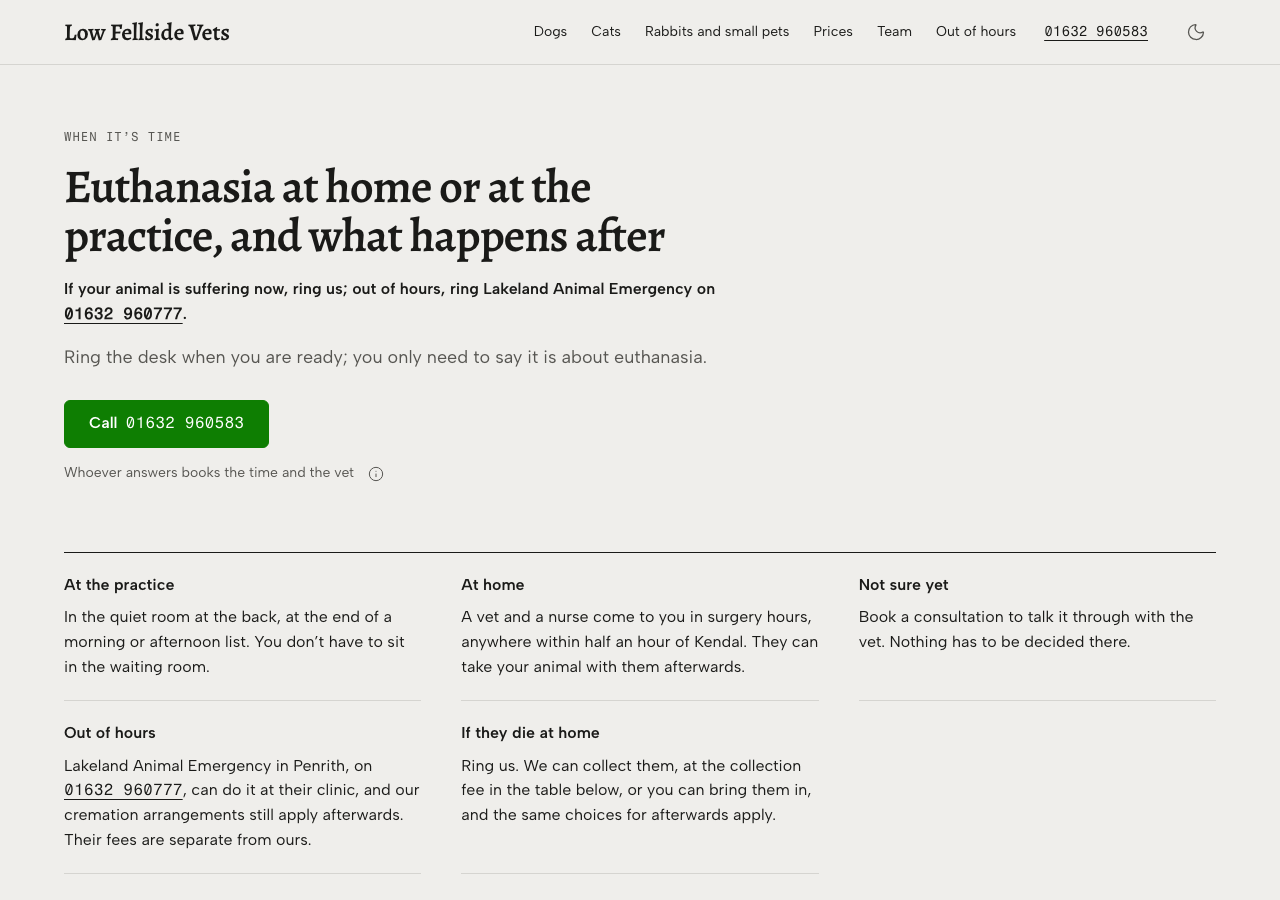
- end-of-life-opener
- end-of-life-room
- end-of-life-after
- end-of-life-fees
- +1
- site-header
- site-footer
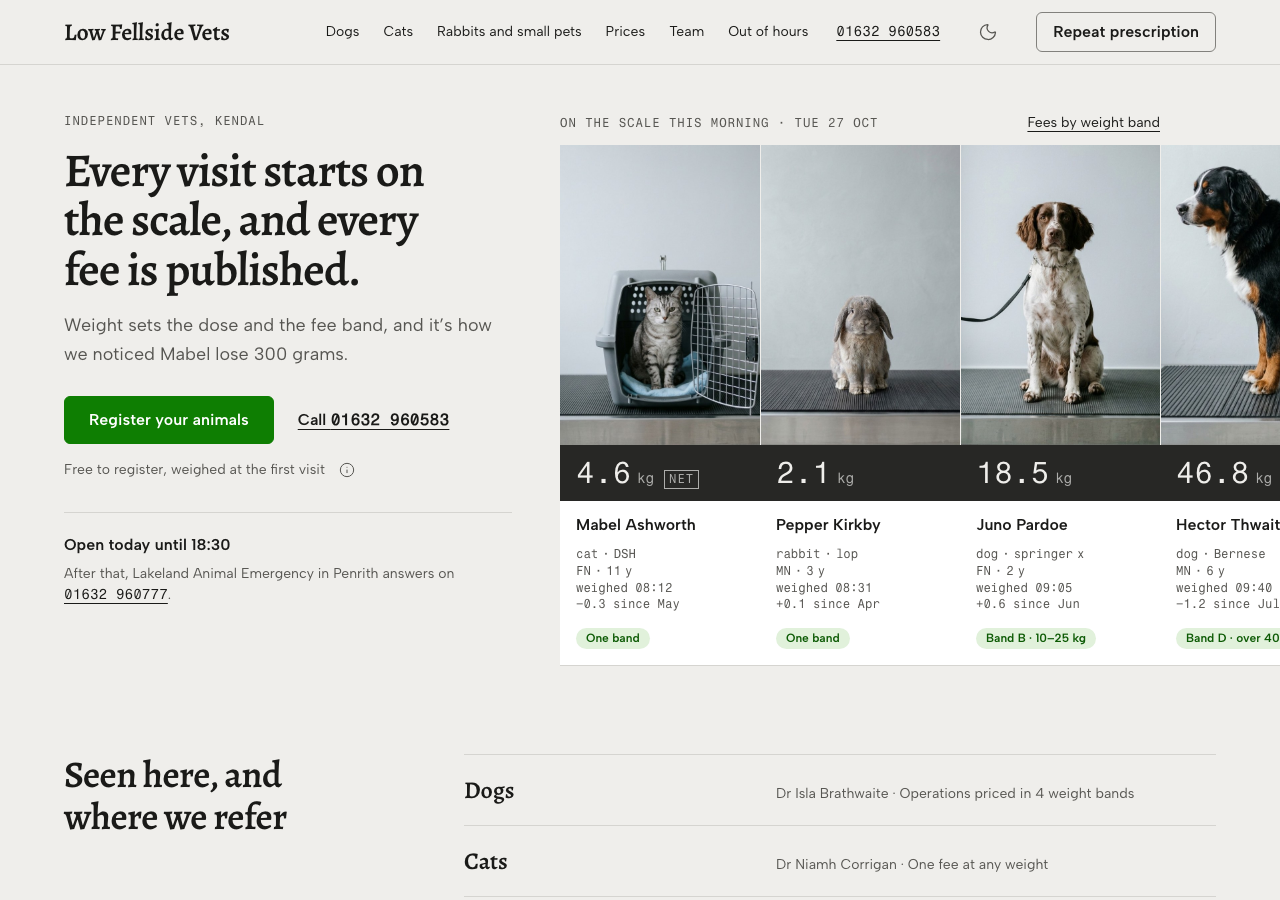
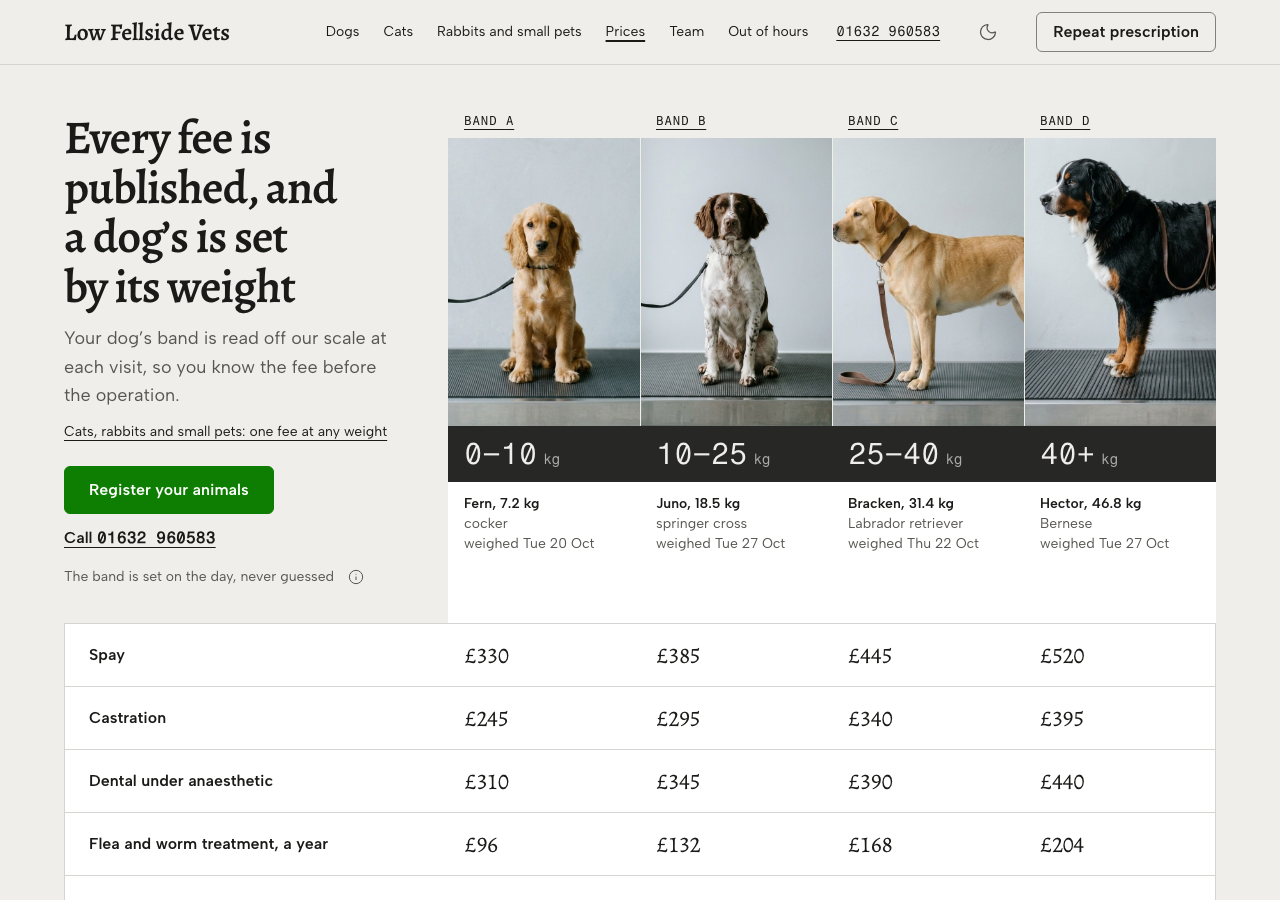
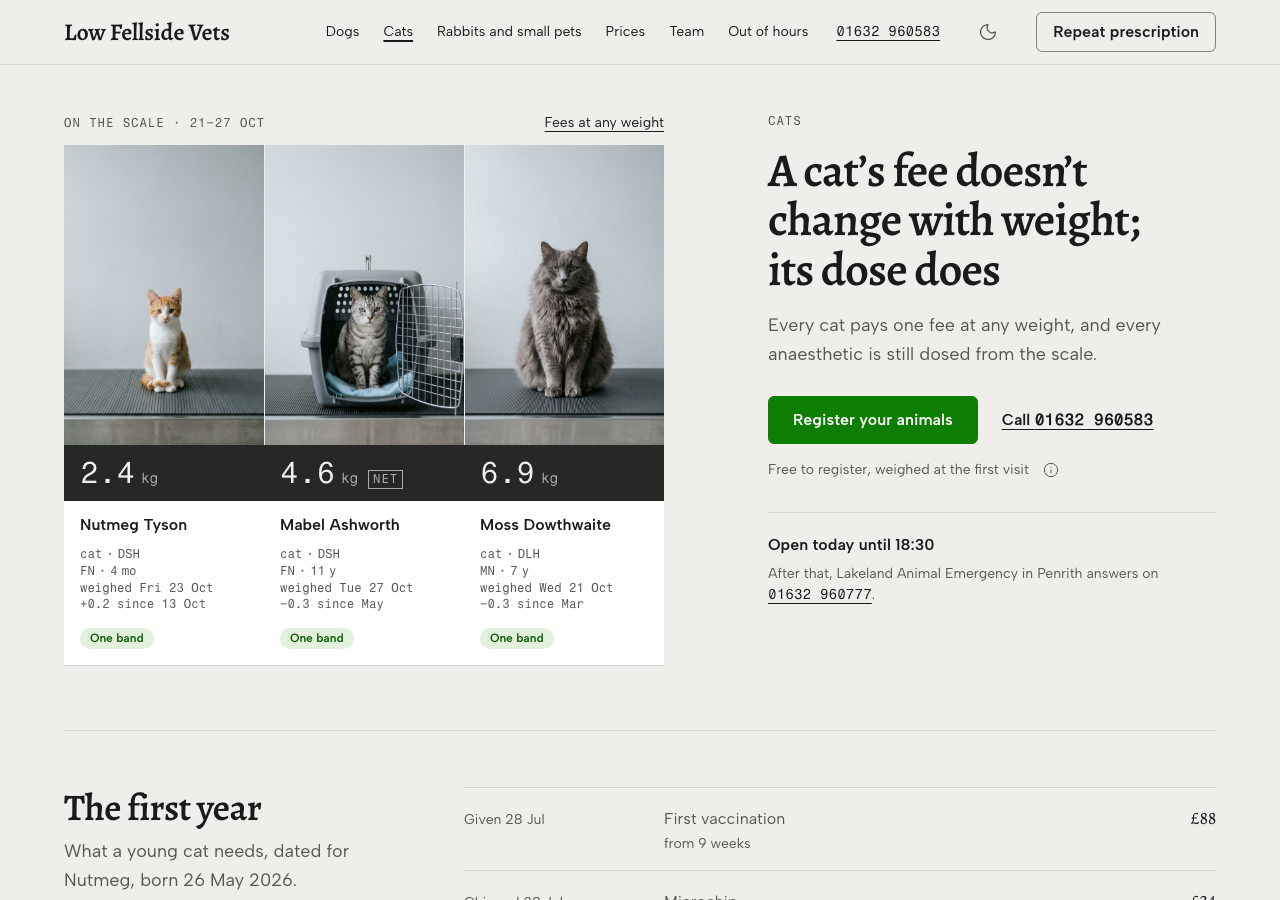
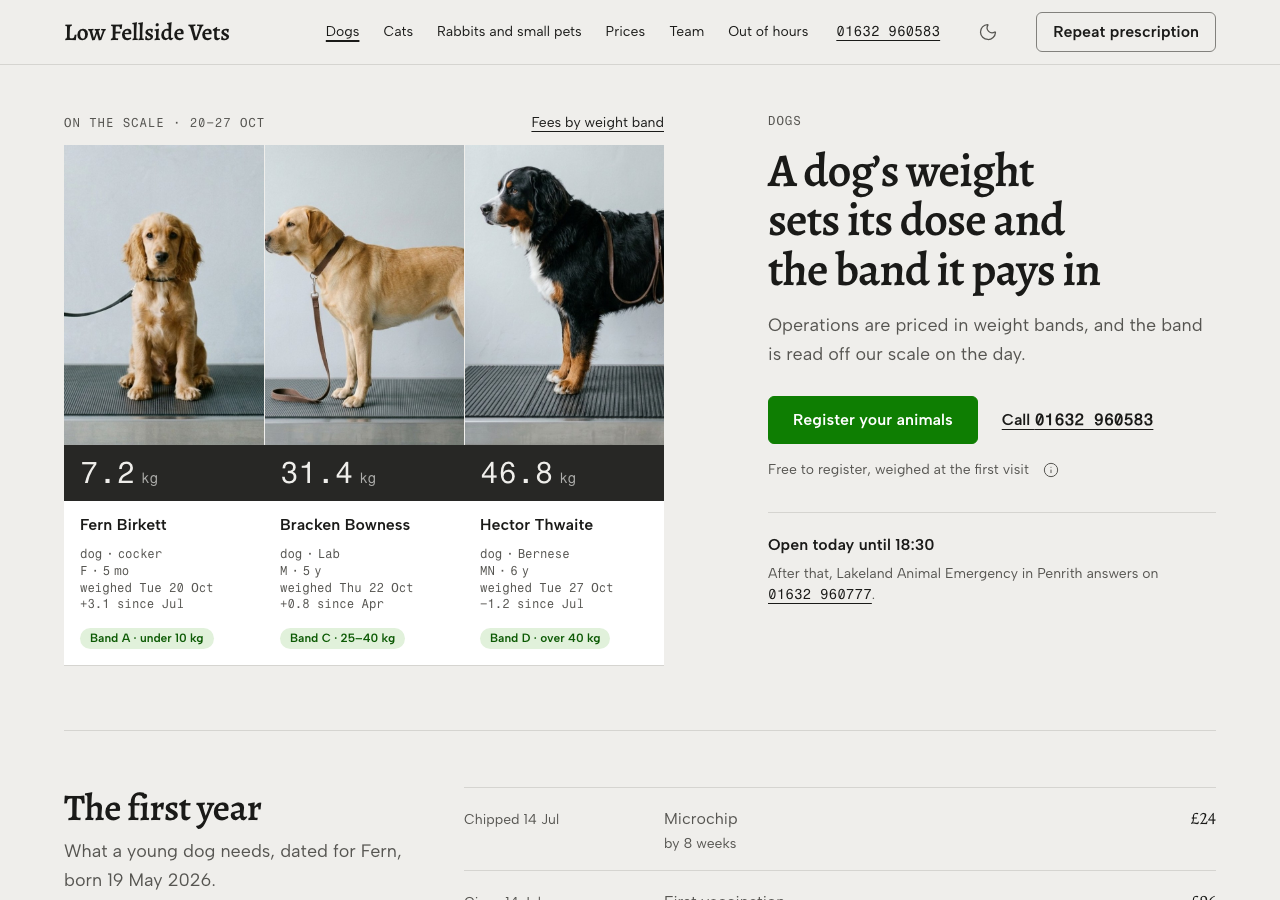
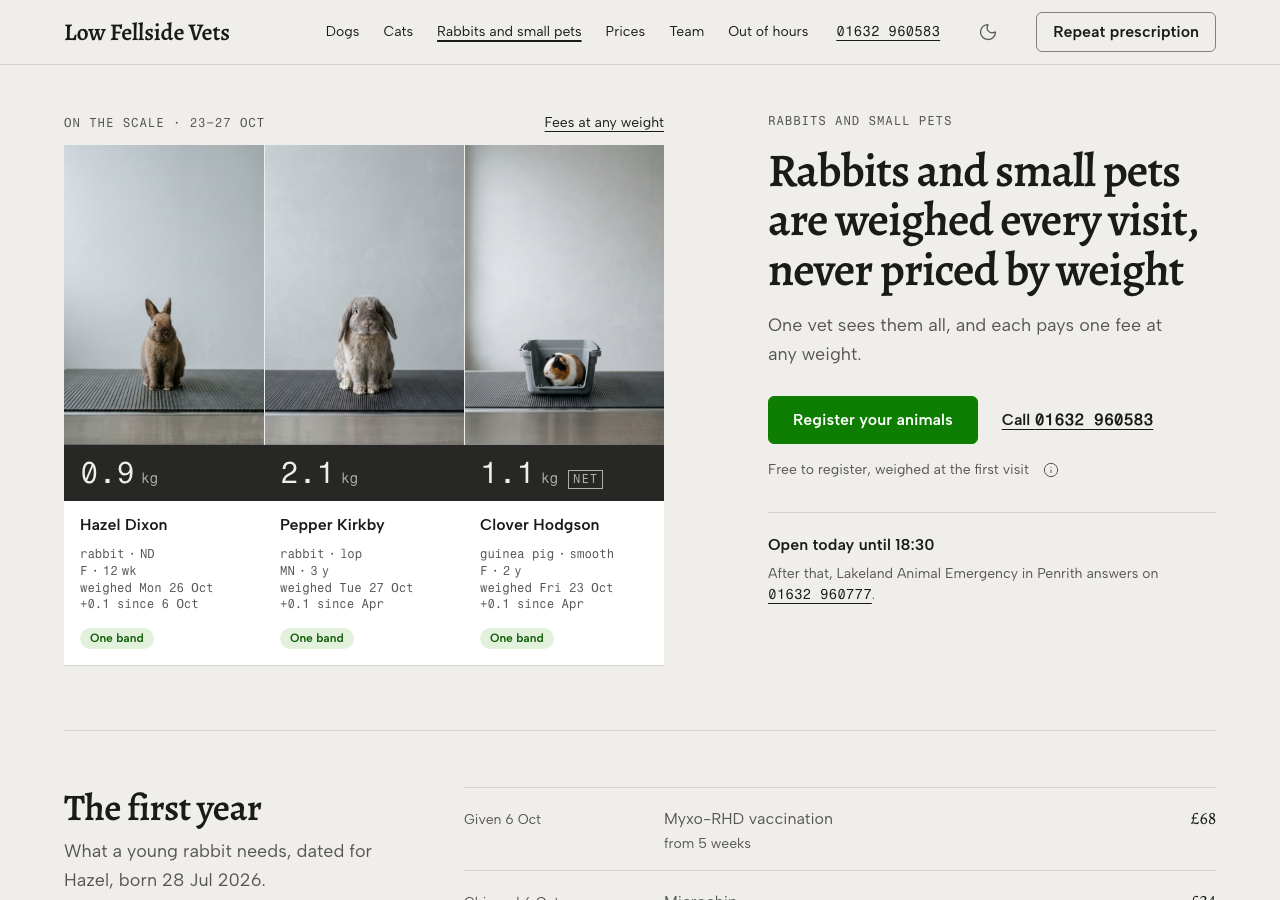
Every animal is weighed in on the page: photographed from one fixed camera, standing on one long waiting-room scale whose graphite edge carries its reading in kg, with a ticket hanging under it that names the fee band the weight puts it in. The fee list is published in full by species and weight band, a household registers all its animals in one form, the out-of-hours page names the partner practice the way the RCVS expects, and an end-of-life page says what happens and what it costs. Light and dark, in React and plain HTML, every figure derived from one fixture that refuses an impossible weight at build, and AGENTS.md gives your coding agent the rules.
sections and primitives
You get the parts, not just the demo site. Every frame is a real capture from the theme's own styleguide page, and the source path under it is where the file lands in your project. 38 frames cover them, with 7 primitives sharing the ui/* frame.
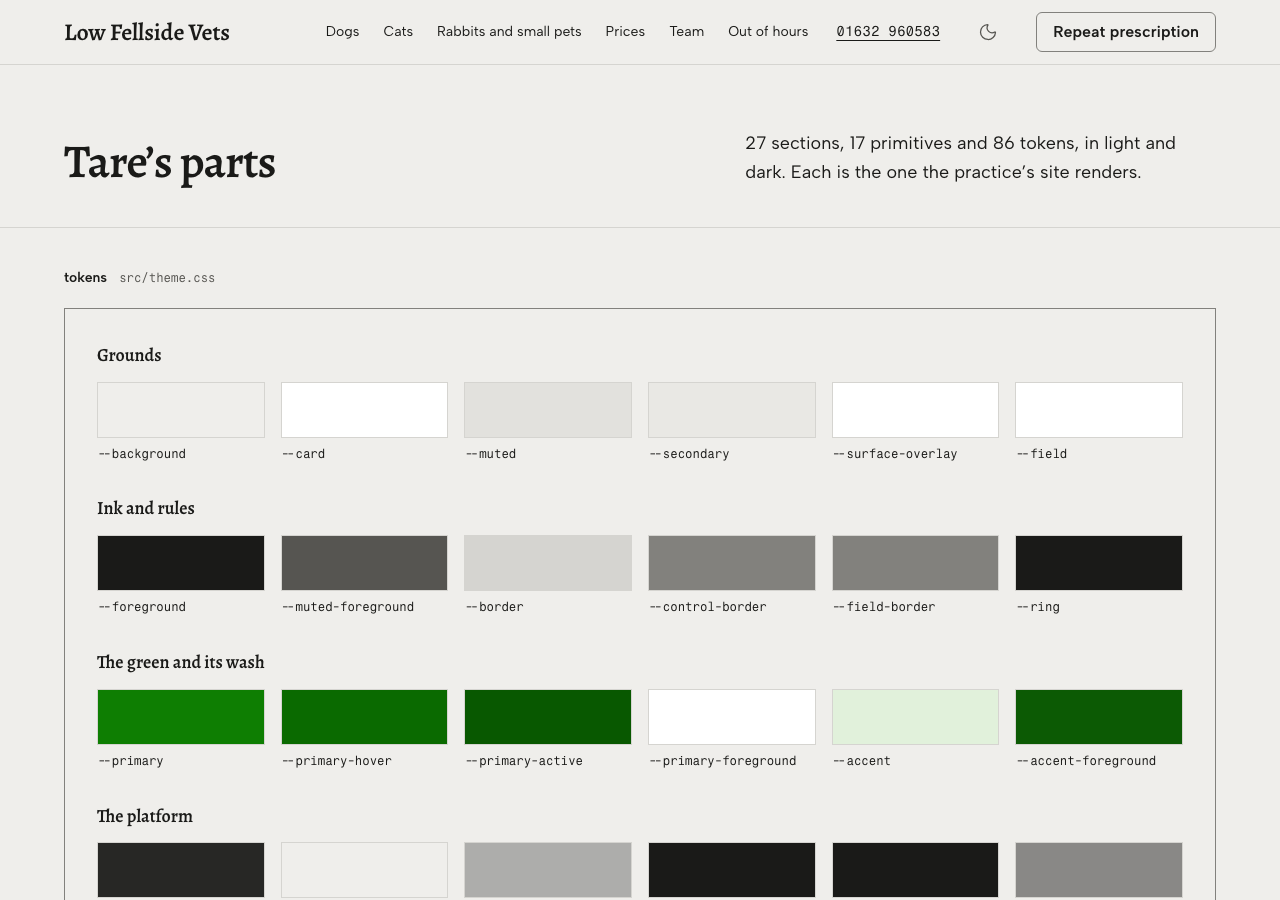
tokens, both modes
Change one variable and every part follows. Each badge is one token split down the middle: its light value on the left, its dark value on the right, with the theme's own paired ink on both halves.
hover or tab a badge for its name and both values, enter copies
The weigh-in: a row of plates photographed from one fixed camera abut with no gutter over one continuous graphite platform, the scale's front edge, whose cell under each animal carries its reading in Fragment Mono with kg (and NET when a carrier was tared) on the baseline; beneath it hangs a ticket with the name, the signalment in the vet's own shorthand, the time weighed, the change since the last weigh-in and the band chip that weight puts the animal in for this practice's fees. Implemented in src/components/ui/platform.tsx, ui/readout.tsx and ui/ticket.tsx; weighIn(), bandFor(), signalment() and trend() in src/fixtures/derive.ts throw at import on an impossible weight, a band gap or overlap, an impossible sex code, a tare at or above the gross, and a chip that disagrees with bandFor(). It recurs on /, /prices (band heads), /animals/[species], /register (the empty platform), /team and /health-plan, and is withheld on /when-its-time.
every token
typefaces, self-hosted
Real woff2 files in src/fonts/, wired through next/font and licensed under OFL. Nothing is fetched from Google at build time, so the zip renders these letterforms offline. Scale ratio 1.25.
Tare
Tare is a veterinary clinic tailwind template for the developer building a site for an independent small-animal practice whose clients ask what a spay costs for a 30 kg dog.
const { open, close } = useLedger("2026-03") // 0123456789
- display
- Alegreya
- text
- Albert Sans
- mono
- Fragment Mono
- captionAg
- smallAg
- bodyAg
- leadAg
- d1Ag
- d2Ag
- d3Ag
- d4Ag
every width is a real render from the publish gate
Four viewports, each one a render the gate produced and checked. Switch between them: the frame narrows exactly as a window does, because that is what it is.
every token and every part on one page
The styleguide route is not documentation about the theme. It is a page in the zip that renders the real components from the real tokens, so it stays true the day you change one.
files in the zip
Two independently authored editions: React for applications, plus ready HTML, CSS and vanilla JavaScript for static hosts.
- AGENTS.mdthe theme's own rules, written for an agent
- .claude/skills/4 skills, each one job
- add-page/SKILL.mdAdd a route to Tare
- add-section/SKILL.mdAdd a section to a Tare route
- check-quality/SKILL.mdRun Tare's own quality checks on your copy of the theme
- rebrand/SKILL.mdPut a real veterinary practice into Tare
- src/
- theme.css86 tokens, light and dark
- fonts.tsthe faces, wired to the type tokens
- app/8 files
- components/27 files
- ui/18 files
- assets/1 markdown file, 1 file
- fonts/5 font files, 3 licenses
- app/11 routes, plus layout.tsx and globals.css
- theme.jsonthe manifest: tokens, components, pages
- html/the framework-free edition
- dist/11 compiled routes, deploy-ready — no build step
- src/the Nunjucks source the routes compile from
- scripts/build-html.ts · serve-html.ts — `bun run build:html` / `preview:html`
- README.mdquickstart
- 6 project filespackage.json · tsconfig.json · next.config.ts · postcss.config.mjs · env.d.ts · .gitignore
Your key goes in TAILTHEMES_LICENSE_KEY, and the registry entry goes in components.json. The snippet is on the docs page.
skills your agent can run
Your agent reads AGENTS.md before it edits, then runs the skill that fits the change. The skills are the theme's own, and the publish gate makes an agent complete every one of them in a scratch copy before the theme goes live.
44 components, 11 pages and 86 tokens, as a Next.js project.
AGENTS.md carries the design spec. Each skill is one job written against it.
Claude Code, Codex, or any agent that reads AGENTS.md. It runs on your machine, on your own account.
Built from the theme's own sections, on the same tokens and the same rhythm.
The source is yours to run, edit and deploy.
The spec ships inside the folder, so the page your agent adds next month is built by the same rules as the ten it came with. Nothing calls back here.
What the standard license coversWhat do I actually get?
Does it include the pages I'd otherwise have to build?
Will it work with my stack?
How long before it stops looking like a template?
Can I use it for client work?
activity
- v1.0.0: First release: a veterinary practice site where every animal is weighed in on one scale and its weight sets its fee band, in React and plain HTML
- v1.0.0: First release: a veterinary practice site where every animal is weighed in on one scale and its weight sets its fee band, in React and plain HTML
for agents
This listing is also a markdown document and a JSON endpoint. The theme's own agent kit is on the kit and agents plates above.